Steel spotters: how to choose one (current, programmes)
The spotter is often the first machine you buy when setting up a bodyshop, and the one you use every day. Between 3,800 A and 7,500 A models, two-knob controls and screens full of programmes, it's easy to hesitate. Here are the criteria that really matter in day-to-day use.
What a spotter does, and what it doesn't
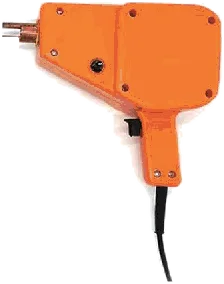
A spotter, or stud welder, resistance-welds a small element onto the panel: a washer, a star, a ring, a stud or a wiggle wire. You then pull on it with a slide hammer or a lever to bring the panel back, snap the element off with a twist of the wrist and grind the spot flat. It's the tool for dents you can't reach from behind: sills, rear wings, B-pillars, inner door panels.
The same machine is also used to shrink stretched metal with the carbon electrode, to do single-sided spot welding and, on some models, to weld studs. On the other hand, a spotter replaces neither a straightening bench for structural damage nor an aluminium unit for aluminium panels: the discharge from a steel spotter will not weld aluminium, that's a different process.
Current and power: how much do you really need?
The figure spotters are sold on is the maximum welding current: 3,800 A, 5,600 A, 7,500 A. It's a very brief current, lasting a few hundredths of a second, at a very low voltage. The higher it is, the faster and cleaner the spot, which limits heat build-up around it and the loss of corrosion protection on the back of the panel.
For everyday panel work on a light vehicle, between 0.6 and 1 mm, a spotter in the 3,800 A class does the job. More powerful models come into their own on galvanised panels, where you need a high current and a very short time to weld without burning off the zinc, and on wiggle wires or larger studs that draw more. Also look at continuous power and the supply: a machine that needs a three-phase line is no problem in an equipped workshop, but it is when you're working on a customer's premises.
A word on the earth cable: clamp it on a bare-metal area, as close as possible to the repair. A distant or loose earth loses a good share of the power and gives spots that don't hold, whatever the machine.
Settings: two knobs or full control
There are two schools of thought. On simple microprocessor spotters, you choose the tool and a power level, and the machine manages the weld time. It's quick, hard to knock out of adjustment, and ideal for a workshop where several people use the machine. On more complete models, you set current and time separately, sometimes over 80 power levels and 99 time levels.
Separate adjustment is not a gimmick. On thin galvanised sheet or high-strength steel, it's what lets you make a small, hard, short spot that holds well and preserves the coating. If you work a lot on recent vehicles, this matters more than the headline current.
Triggering matters too. In automatic mode, the spot fires as soon as the tool touches the panel: handy for putting on washers one after another. In manual mode, it fires on the trigger: safer for placing a star or a ring precisely. Having both modes on the same machine is a real comfort.
Programmes and accessories to check
The programmes match the tools: star, washer, OT ring, wiggle wire, stud, carbon electrode for heating and shrinking, single-sided spot welding. Check that the ones you need are there and, above all, that the matching accessories are supplied. A spotter without a slide hammer, pulling claw or carbon electrodes means buying them straight away.
The wiggle wire deserves a mention. Welded at several points along a line, it lets you pull out a long deformation, such as a wheel arch or a body line, evenly. It saves a huge amount of time compared with a row of washers. Also consider a continuous washer gun, which saves reloading at every spot on large areas.
- Slide hammer and multi-hook pulling claw
- Stars, washers, OT rings and wiggle wires
- Electrode holder and carbon electrodes
- Trolley if the machine has to move around the workshop
Format: trolley, portable or cordless
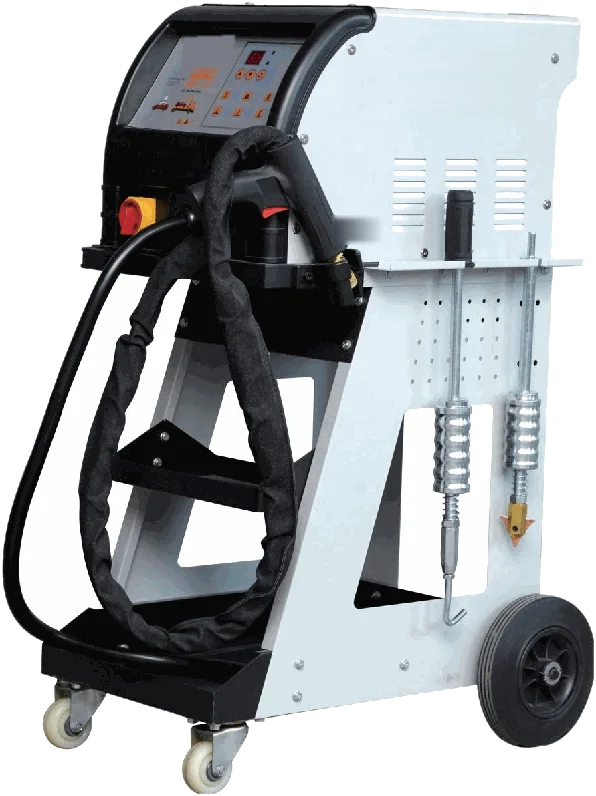
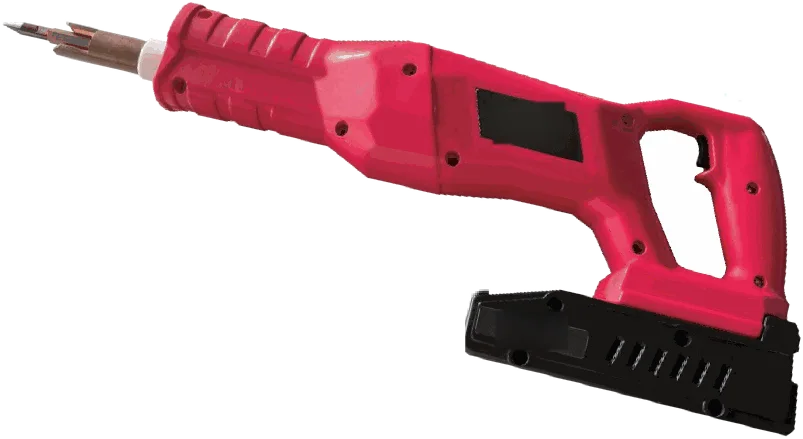
A trolley-mounted spotter, with its tools stored on board, stays at the panel bay and moves from one vehicle to the next. A portable model in a case is better suited if you work at customers' homes or at trade customers' premises. Cordless battery spotters have neither a mains cable nor an earth cable: they don't replace a workshop machine on a big job, but they are very handy for a small dent or a quick pull outdoors.
Finally, bear maintenance in mind. Tips wear, cables take a beating, stars get bent: check that consumables and spare parts are available in France, so you aren't waiting six weeks for a replacement gun.
Humming Equipment spotters
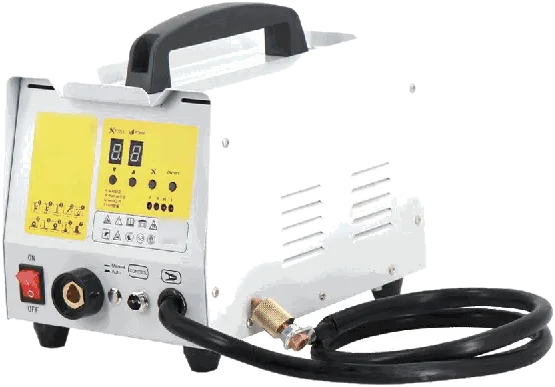
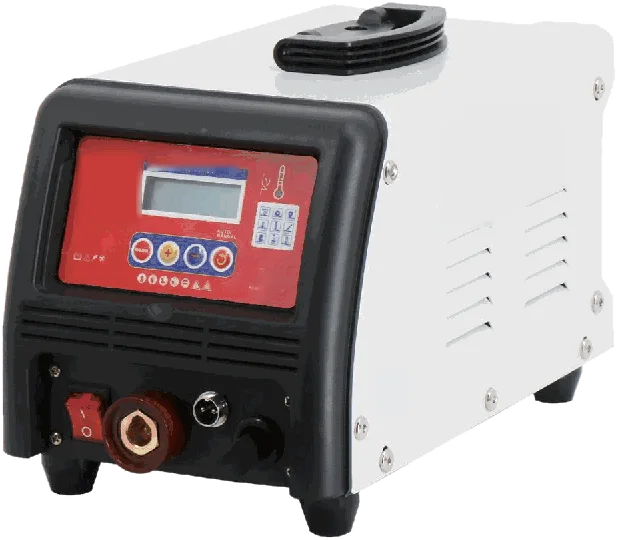
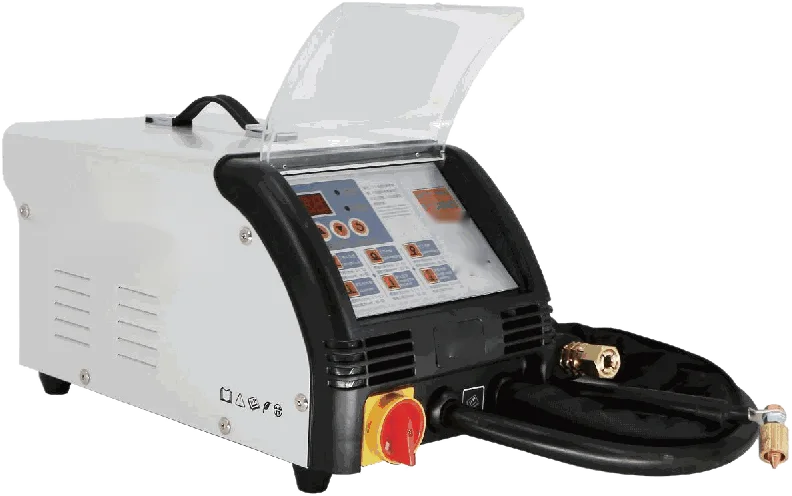
The range runs from the compact HE-D101 spotter (3,800 A, 7 tools × 11 levels) to the HE-D105 with LCD screen, 80 power levels and 99 time levels, up to the HE-D106 (5,600 A) and HE-D116 (7,500 A) with independent current and time adjustment, designed for thin galvanised panels. For small jobs, there's the HE-D123 mini spotter and the HE-D121 cordless spotter. Consumables are grouped under HE-A702. Your Humming distributor can let you try the machine that suits your workshop.
The values given here are workshop guidelines. The product's technical data sheet always takes precedence.